Sunday, November 8, 2015

Ö – A Möbius Trip at Färgfabriken


13

Isabel Löfgren & Peter Lang – Experiencing Sites in Movement: Ö-A Möbius Trip and Stalker walks

Welcome to the presentation of  “Ö – A Möbius Trip,” 11am, November 12 . Artist Isabel Löfgren together with Peter Lang (professor in Architectural Theory and History at the Royal Institute of Art and member of Stalker) will take the audience on a psychic exploration of  thinking related to the archipelago, Nordic mythology, nomadism and heterotopic locations.

The event takes its starting point in “Ö – A Möbius Trip,” a publication that documents a voyage with the goal of finding a mysterious island in the Stockholm archipelago. The investigation was undertaken by a group of international artists inspired by Homer’s Odyssey and was born from a series of research voyages and actions in and through the Stockholm archipelago.
The publication is co-edited by Isabel Löfgren and Per Hüttner. It is produced by Vision Forum and participating artists are: Cecilia Ahlqvist, Valerio del Baglivo, Andrea Hvistendahl, Marcia Moraes, Lillevan, Egill Saebjörnsson, Camila Sposati, Samon Takahashi and special appearances by Atle Baekken, Mats Hjelm, Jean-Louis Huhta and Emilia Rota.

November 13, 11 am Färgfabriken – part of MARETOPIA, curated by Kristina Lindemann and Jens Evaldsson

Maretopia is a vision of a floating culture house that relates to its context in an eco-conscious way and promotes the production and experience of art on the waters of Stockholm. Maretopia is a public place to experience and discuss artistic and scientific content. It is a collaboration with students and teachers of Konstfack’s department for Interior Architecture and Furniture Design and realized with the kind support from Konstfrämjandet and Färgfabriken.

Friday, August 28, 2015

Lunchtime session at Hallwylska: Dream of the Palace – Ö – OuUnPo


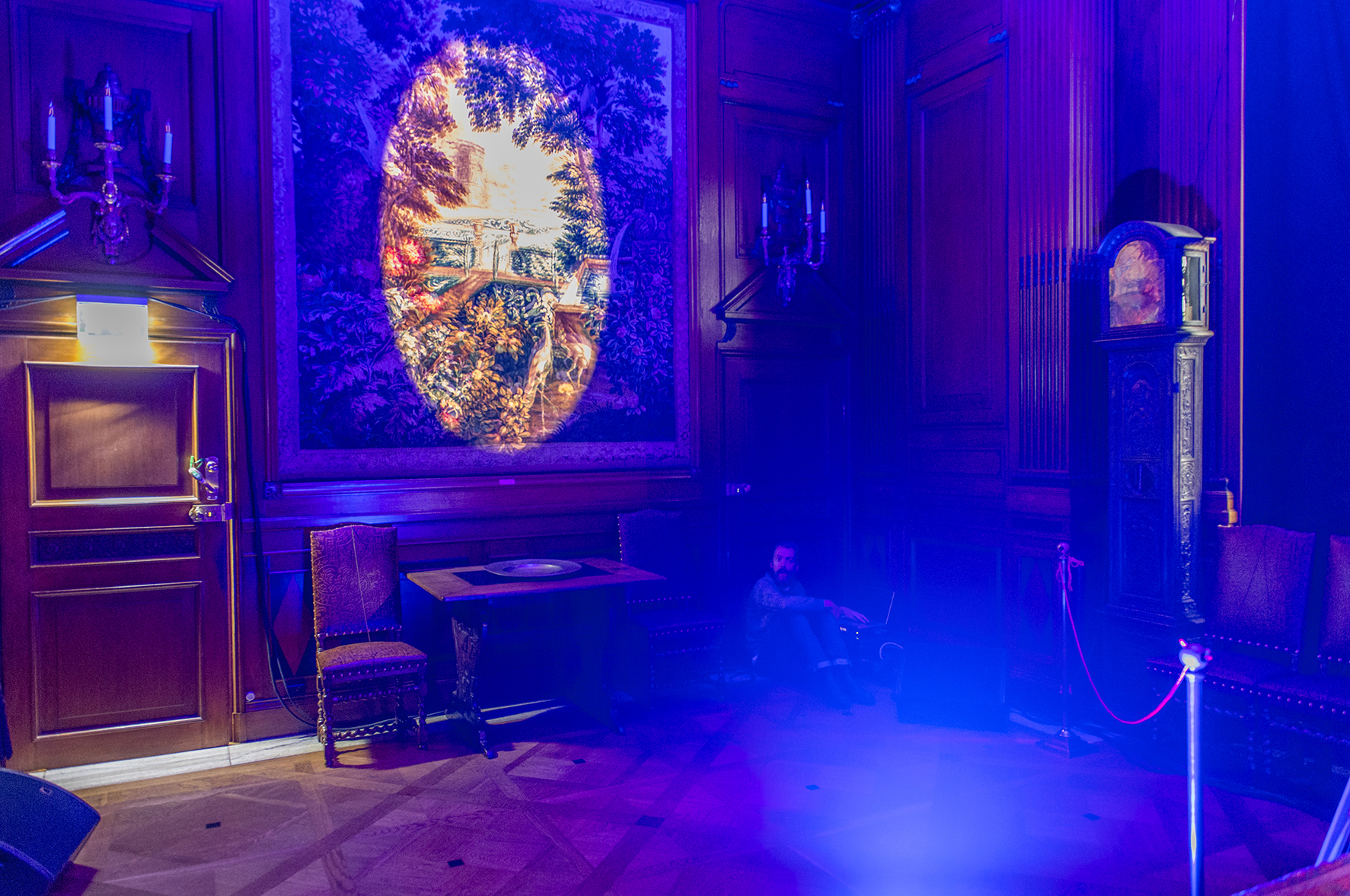
Welcome to the Hallwyl Museum on September 15 for a satellite event of the XIV OuUnPo Session – a lunchtime session with a gesamtkunstwerk created by Henrik Sputnes and Vilma Luostarinen in collaboration with artists Felicia Atkinson and Rasmus Persson + release of the publication Ö.
Named after a 13th century painting by Giotto, Dream of the Palace is an obscure place of lost memories, an environment which reflects the mental processes of remembrance and forgetting – a composition of light, sound, scent and objects. In the centre is the sound sculpture APOEMAS by French artist Felicia Atkinson, an abstract and ambient collage of sound fragments accompanied by a light installation by Rasmus Persson.

45 Dream of the Palace Foto Ari Luostarinen

The experience will also include the launch of the publication “Ö – A Möbius Trip”, the exploration of a mysterious island in the Stockholm archipelago by a group of international artists. The expedition leaders, Per Hüttner and Isabel Löfgren, will lead you into mazes where the mystery of islands and fantastical thinking allow you to encounter the unfamiliar in an alternative and expanded universe. Participating artists are: Cecilia Ahlqvist, Valerio del Baglivo, Andrea Hvistendahl, Marcia Moraes, Lillevan, Egill Saebjörnsson, Camila Sposati, Samon Takahashi, and special appearances by Atle Baekken, Mats Hjelm, Jean-Louis Huhta and Emilia Rota.

37 Dream of the Palace Foto Ari Luostarinen

Dream of the Palace is a satellite of the previous session that OuUnPo held in last February in Stockholm. The theme revolved around the state of fugue; a dissociative amnesia in which the patient wanders into a temporary new identity.

OuUnPo is an international artist and research group which forms a part of the organisation Vision Forum, committed to promoting and supporting artistic projects by combining art, research and education. More information about OuUnPo and the previous session can be found on ouunpo.com.
The event is organised by Naïvité, a curatorial duo and a platform for contemporary art and experiences. Their work is characterised by research, narratives and the creation of collaborative gesamtkunstwerk. Henrik Sputnes is a curator and project manager based in Gothenburg and Vilma Luostarinen is a London-based curator. In collaboration with Hallwylska museet and with support from Stockholms Stad. Special thanks to Lisa Sputnes Mouwitz, Ari Luostarinen and Carima Neusser. Photos by Ari Luostarinen

49 Dream of the Palace Foto Ari Luostarinen

Wednesday, January 7, 2015

Almost there...


Our heroic designer Erik Månsson is putting the final touches to the Ö catalogue that documents the project's activities. The publication and connected CD will be presented at release events in Stockholm and London in September 2015.

Sunday, March 9, 2014

Ö at Normalcy in Stockholm


Vision Forum node Ö - A Möbius Trip will participate at Normalcy Bar at Moderna Bar April 25, 2014, Moderna Museet, Skeppsholmen, with Radio Ö.

In 2011, a group of artists embarked on a trip in the Stockholm archipelago in search of a lost island. According to marine archaeologist Atle Baekken, the existence of this island had been kept alive in myth and song within the old villages of the archipelago. But the knowledge of its exact location has been lost as the archipelago has now been transformed from a place of subsistence (fishing, farming, etc.) to a gigantic touristic resort attracting thousands of sailors and wealthy owners of summer homes every year.

Wednesday, February 5, 2014

Ghost Writer


The Ö-crew is very happy to announce that we have appointed a writer for the publication. However, he/she will writing under pseudonym, so we will not publicize his name. He/she is standing behind the monument above, so just have a look on the other side and you will find out who it is.

In the foreword our author claims that we made Odysseus and Poseidon friends on our journey. We are of course very happy to have created peace after almost 3000 years of rivalry. Or will the evil radio enthusiasm with his conspiracy theories and mechanical seagulls ruin the long sought after peace? You will soon find out.

Thursday, September 5, 2013

Working with the Book


After three successful sessions we are now hard at work creating a publication that documents the journeys. Please check back here to find out more about the progress and don't lose track of your compass. For more info about other Vision Forum publications, please look here.

Thursday, July 25, 2013

Sold Out


We are happy (and sad) to announce that there are no more tickets available for the Ö adventure. If you want to stay on a waiting list, please contact Rudi on "info (at) visionforum.eu" and he will take your name. Please remember to indicate which day you want to go and how many people.

Thursday, July 18, 2013

Tickets still on sale


Tickets for July 25 are sold out. But their are still a few available for July 26 and 27. We trip lasts 6 hours and the price is 475 sek/person and includes starter, main course and desert along with drinks. To book your ticket contact Rudi Heinrichsen on info (at) visionforum.eu.

Tuesday, April 9, 2013

Ready for Departure


The dates for the trip has been set. Make sure that you keep your agendas open August 25-27, 2013. A magical journey through the Stockholm archipelago awaits you! More info here.

Monday, October 29, 2012

Lanzarote!


INSPIRATION 

Rasmus Spanggaard Troelsen
Onderzoeker ontwerpen / Researcher Design
01.01.11 – 31.12.11
info@rasmustroelsen.dk
rasmustroelsen.dk
My research focuses on the design of the Canary Island Lanzarote by César Manrique.

The poet John Donne wrote that “No man is an island”. However, the argument could be made that one man is Lanzarote; or rather that one man alone has shaped the image of Lanzarote. César Manrique (1919–1992) has designed everything on the island – from the road network to the uniforms worn by all museum personnel; from the regulations regarding the colour of window frames to the island’s logo.

Afraid of the effects that the growing global tourist industry might have on the island and its environment, but realising its economical potential, Manrique emerged in the late 60s with ideas of control and conservation. As a counterpoint to free-market hotel tower blocks for what he called the ‘avalanche of tourists approaching Lanzarote’, he proposed a combination of highly commercial elements and preservation of the natural milieu – a strong homogeneous image of an authentic (unspoiled) Lanzarote. This meant an architecture that emphasised the volcanic environment of the island, heavy restrictions on town planning, a uniform visual language and a narrow aesthetic field based on an invented folk tradition. This image of Lanzarote is still maintained today.

I plan to map out the history of design and César Manrique on Lanzarote, looking at both socio-political transformations and specific designed objects, in order to examine the relationship between power and form. The aim is to describe how the impenetrable image of Lanzarote functions; to draw parallels to a world that generally seems to become more and more designed as image; and to investigate how/if/where resistance to such ‘total design’ is possible.
The outcome will be an extended tour of the island.

More here http://www.janvaneyck.nl/post/13402891962/rasmus-spanggaard-troelsen-onderzoeker-ontwerpen

Thursday, October 11, 2012

Ö - 3rd Workshop in Stockholm


Welcome to our third meeting. Our residency will be a little bit different this time. We will be staying in the city, visiting our boat, and doing activities around Stockholm - the archipelago city. 
The intention this time is to work together on the final concept and get into the details of how we will "choreograph" the experience into the 5 hour trip. Knowing what the boat is like will make it easier for us to finally model our work against a more real scenario. It will also be a great opportunity to discuss your proposals and further refine them into a plan we can work with for the final production next summer!
One of our activities will entail being outside for one afternoon. Please bring warm clothes, raingear, and hiking shoes/boots  - Temperatures during the day are around 12ºC but it drops at night to about 6ºC. Therefore, bring a good jacket and caps/gloves - you will need it!! We are almost in the North Pole, remember?

Sunday, September 2, 2012

Second Workshop - The Island version 2.0


Since we last met in Sandhamn last autumn and defined the general shape of the trip and of the experience, Per and I have developed the concept so that it becomes even tighter and gives us a main concept to work through during our mini-residency.

Per and I came to the conclusion that both we, the artists, and the audience need to somehow share a common goal, a common 'quest' so that the odyssey can come into full bloom. Everyone on the boat will embark on trying to find the point where the island was, and that point lies in the fold of the Moebius strip which is what shapes our trajectory.

Wednesday, July 11, 2012

Benjamin from Attica

Following Isabel's exquisite map, I will give you some relevant quotes from Benjamin from his amazing text about Kafka. (It is available in Illuminations, that you can read here.) I am re-reading this text with my feet in the Aegean Sea, surrounded by a beautiful archipelago. So you can see that I am hard at research.

What Benjamin is looking for is deafness rather than blindness, or maybe just silence? Either way we are close to 4'33" and our experiments in Stockholm.

So remember, whatever you are doing this summer and wherever you are, to use the gods as shields and become silent Sirens. I round this off with another image of my search for Poseidon in the Pyrenées. We never found him, but created three new Ambassadors.


Enough enigmas for today?

-Per

Tuesday, July 3, 2012

This map is an illustration in ‘The Hunting of the Snark (An Agony in 8 Fits)’, a nonsensical and somewhat grim poem by Lewis Carroll, who is better known for ‘Alice in Wonderland’. All the illustrations in ‘Snark’, first published in 1876, are by Henry Holiday, whom I therefore suppose to also be the author of this map.

 The map is an Ocean Chart owned by the Bellman, one of the main characters in the book. It helps the Bellman and his fellow adventurers, who are hunting for a legendary beast called the Snark, to cross the ocean and arrive at a strange land. The absurdity of the map is that it only shows ocean, literally illustrating nothing, and therefore cannot be a very helpful navigating tool.

Here’s an extract from ‘Snark’ relating to said map:

 He had bought a large map representing the sea,
Without the least vestige of land:
And the crew were much pleased when they found it to be
A map they could all understand.

 “What’s the good of Mercator’s North Poles and Equators,
Tropics, Zones, and Meridian Lines?” 
So the Bellman would cry: and the crew would reply
“They are merely conventional signs!

 “Other maps are such shapes, with their islands and capes!
But we’ve got our brave Captain to thank: 
(So the crew would protest) “that he’s bought us the best—
A perfect and absolute blank!”

Friday, June 1, 2012

Archetypal characters versus archetypal settings

As we embark on to the island and think more clearly about how to shape the experience on the boat, it is useful to think of the island, as well as the boat, as archetypical settings. Settings that are loaded with a significance that permeate history, time and culture. In western culture, the island is a very strong archetype, whereas in Chinese literature the corresponding archetype would be that of the mountain. According to Edward John Federenko, "the typical island story involves a character in many, if not all, of the following: removal to a remote island; awakening to, and taking stock of, strange surroundings; initial setbacks followed by increasing adaptation; spiritual, emotional, or psychological growth due specifically to island experiences; a climactic event which challenges growing feelings of wholeness; and escape and return to the home society in a much-altered state. Let's trace the influence of the island on the castaway story in terms of six archetypes: wanderer, hermit, artist, magician, king, and hero. Jung refers to the influence on the psyche of certain places and situations when he says that "only in the region of danger (watery abyss, cavern, forest, island, castle, etc.) can one find the "treasure hard to attain" (jewel, virgin, life-potion, victory over death)" (Collected Works 12:438). But the specific workings of the archetypal place as agent of change receives less than full elaboration in Jung's work; Jung was concerned primarily with describing archetypal figures and their effect on individuation. How does the archetypal setting inspire human transformation? The conclusion from examining the function of these six archetypes in island fiction is that they are given impetus by the island setting because of the island's remoteness from the castaway's home society and the island's isolation from all other societies. Jung notes that a particular kind of psychic energy flourishes in isolation resulting in "an animation of the psychic atmosphere, as a substitute for loss of contact with other people" (CW 12:57). The island--a kind of incubator--exerts a more active influence on a character's growth in island fiction than has hitherto been acknowledged." more here

Wednesday, May 16, 2012

There will be real big oil...

Next week I will be in Ireland, and meeting with artists, among which Sarah Browne, whose artist Kennedy Browne has done really great work mainly about the effects of recent economic decisions concerning globalisation and Ireland. I transcribe here the description of the project (the big one) which is all about islands... (the big one) Kennedy Browne, DVD, 5 minutes, 2006 “an island, never seen by human eye nor walked by human foot” (the big one) is an artists’ cut of a 1970s movie. Through the careful editing of this footage the artists re-contextualise what was a fleeting sequence in the original film and re-frame this fragment, thus giving it new meaning abstracted from its original context. The film was originally made around the time of the 1970s oil crises. At this time OPEC countries in the Middle East cut supplies of oil to the West, and caused much insecurity in industrialised America and Europe. This energy insecurity which threatens modern life is again pertinent in the early twenty first century: this is a time some experts reckon to be the era of ‘peak oil’, coinciding with the US military intervention in the Middle East and an earnest search for energy alternatives. The reframing of this film takes its structure (classical Hollywood narrative) and subtly subverts it. The dramatic opening to the piece features Fred and Roy of the fictional Petrox Corporation toasting ‘the big one’ of the title. This refers to the record oil strike they will make upon penetrating a mysterious fog bank out at sea, and landing on a previously undiscovered island - virgin territory for them to colonise and exploit. This is of course the utopia of all prospective oil tycoons. However upon penetrating the fog bank things don’t go to plan. Here the very legible structure of the piece breaks down: as the men’s desire to view and conquer the island become corrupted, so does the narrative. Trapped in the fog bank, fading in and out of view, they impatiently await the sighting of the island. The protagonists are engulfed in a never-ending fog searching for the elusive island. The dialogue emphasises ideas of discovery and conquest, but the visuals deny any forward progress. Their journey becomes disconcertingly looped and repetitious, wearing at the once boisterous ambition and optimism of Fred and Roy.

Monday, May 14, 2012

Thinking about the shape of the path

Data visualizations Sphere of Chords Some argue that music is merely a side effect of traits that evolved for other functions. Our perceptual and cognitive abilities may have accidentally resulted in a system that finds pleasure and interest in musical stimulation. This idea should perhaps be the null hypothesis, and is by no means implausible. Music's perceptual basis could derive from general-purpose auditory mechanisms, its syntactic components could be co-opted from language, and its effect on our emotions could be driven by the acoustic similarity of music to other sounds of greater biological relevance, such as speech or animal vocalizations. Familiar relationships between sets of musical notes, such as transposition between chords, directly translate into geometrical structures such as this Moebius strip - where each dot represents a whole class of equivalent two-note chords - or into more complex structures with many dimensions. Composers have an understanding of these geometries without realizing it, (...). Excerpts from: "The Evolution Of Music" by Josh McDermott. © Copyright 2010 Michael Paukner. All Rights Reserved.

Saturday, May 5, 2012

Japanese Inspirations for Ö


 Here is some inspiration for Ö from Japan:


Maybe some merrily clad musicians that
play for school children under home-made
banners?


 Or why not follow the Tokyo Police and stand cockily on a massive stage/barge while it is
pulled/pushed by two tugging boats?

Monday, April 30, 2012

The science of walking, the science of travel?

Lucius Burckhardt, a Swiss sociologist and architect invented strollology and promenadology. Here is a small excerpt about 'discovery' and a methodology for wandering...maybe useful for us? The South Sea Pavilion, one of the earliest purpose-built museums in Germany, houses the South Sea collection of Reinhold and Georg Forster,which they had donated to the Wörlitz Prince on his visit to England. In 1772, Georg Forster, just 18 years old at the time of departure, took part, together with his father, in James Cook’s second voyage around the world. He published his experiences in a book entitled “Dr Johann Reinhold Forster’s und seines Sohnes Georg Forster’s Reise um die Welt auf Kosten der Grossbritannischen Regierung, zu Erweiterung der Naturkenntniß unternommen und während den Jahren 1772–1775 in dem vom Capitain J. Cook commandirten Schiffe The Resolution ausgeführt.” The voyage brings the world to the home. In exhibitable format, into the world of goods and economic cycles, into imagination, into the landscape of gardens and parks. What to the early 19th century was the art of strolling became the science of strolling in the late 20th century. The Swiss architectural sociologist and theorist Lucius Burckhardt developed, together with his students at Kassel Comprehensive University, strollology or the science of strolling. Its central issues are perception and image composition, what we do at home after the stroll, in the mental processing of what we have seen. An art action entitled “Voyage to Tahiti” sent students to a former military area where a new housing settlement had been developed just outside a nature reserve. With this action, Burckhardt took up the tradition of the discoverers. Students had pre-adjusted their gaze in a specific way, treating the area like an undiscovered island and acting as if they were James Cook or Georg Forster.